
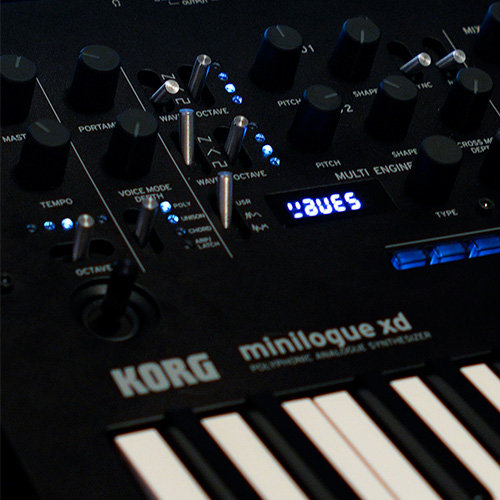
Minilogue XD presets can sound incredible when you audition them on their own, but that doesn’t always mean they’ll work in an actual track. If you’re choosing a Minilogue XD preset bank or sound bank, there are a few practical things worth listening for beyond the initial “wow” factor.
So, you’ve bought a Korg Minilogue XD, or maybe you’ve had one lying around for years and you discover a third-party sound bank whose presets sound fantastic.
You install the sounds, play around with them and then… you barely use them in your actual music or even live jams.
There are plenty of reasons why this happens, and I’ll talk about more of them in future articles. But a big one is what I think of as the “WOW trap.”
A Minilogue XD preset can sound fantastic on its own and still be difficult to use in a finished production.
That doesn’t mean the preset is bad. And it certainly doesn’t mean Minilogue XD sounds generally struggle in a mix.
It’s simply that designing a sound to impress in isolation and designing one to work inside music are slightly different things.
After years of creating sounds for commercial instruments and libraries, this is something I’ve become increasingly conscious of.
The “WOW” Trap: Impressive Isn’t the Same as Useful
When we listen to presets, we’re naturally drawn to sounds that make an immediate impression, that WOW sound, the ear candy.
Wide stereo effects. Long reverbs. Bright harmonics. Movement everywhere.
There’s nothing wrong with that. Some tracks genuinely need those sounds.
But when I’m designing a preset, I’m also thinking about what happens after the first five seconds.
What happens when you add a kick? A bassline? Percussion? Another synth? Vocals?
A sound doesn’t exist in isolation once you’re actually making music.
Space Is Part of a Useful Preset
One of the less obvious parts of preset design is deciding what not to put into a sound.
Not every patch needs an enormous frequency range. Not every pad needs a huge reverb. Not every synth needs maximum stereo width.
Sometimes a slightly darker sound sits perfectly behind a vocal. A focused midrange patch can cut through an arrangement without being loud. A relatively simple bass can work better than something with modulation happening everywhere.
The Minilogue XD is particularly good at this because the architecture is simple enough that you can create focused sounds, while the digital Multi Engine and effects section can add complexity when it’s actually useful.
The important part is knowing when to stop.
A Quick Test for a Minilogue XD Preset
One simple way to judge a preset is to stop auditioning it like a demo sound and start treating it like a part in a track.
Play it in the register where you would actually use it.
If a large reverb or delay is dominating the impression, reduce it for a moment and listen to the underlying patch.
Then put it against a basic rhythm section, bassline, vocal or another synth.
- Does it still have a clear role?
- Does the modulation still help?
- Does it need to be huge to remain interesting?
You don’t need to completely mix the sound before deciding whether it works. The point is simply to find out whether the preset still makes musical sense once it has to share space with something else.
Context Changes How You Hear Presets
Preset demos can also be misleading, even if not necessarily intentionally.
A spectacular sound played by itself might be exactly what you’re looking for.
But when buying a preset bank, I wouldn’t judge it only by its biggest pads, leads or effect-heavy patches.
I’d pay attention to the less dramatic sounds too.
The basses. Keys. Plucks. Short sequences. Straightforward poly sounds.
Those often reveal more about the quality of a preset collection because they’re the sounds you’ll reach for repeatedly when building tracks.
Creating one huge patch isn’t particularly difficult.
Creating a collection where different sounds genuinely serve different musical roles is much harder — and, for me, that’s part of what makes a sound bank worth paying for.
What I Look for in a Minilogue XD Preset
When designing or evaluating a sound, I usually care about a few practical things:
- Does it have a clear musical role?
- Is the frequency range appropriate for that role?
- Does modulation add something rather than simply make the sound busier?
- Are the onboard effects helping the patch?
- Does it respond naturally when actually played?
- Would I personally use it while producing a track?
That last question is probably the most important.
There are endless technically impressive things you can program on a synthesizer, but that doesn’t automatically make them useful sounds.
Why I Demonstrated All 50 Logueform Presets
This was also one of the reasons I decided to demonstrate all 50 presets in Logueform, my Minilogue XD sound bank.
I didn’t want to select five spectacular patches for the video and leave the rest of the bank unknown.
You can hear every sound before buying it.
Some are deliberately immediate. Some are bigger. Others are much simpler and designed to occupy a specific place in an arrangement.
That variety is intentional.
For me, a useful preset bank shouldn’t be fifty variations of the sound that gets the biggest reaction in a demo.
It should give you fifty different reasons to turn on the synthesizer.
The Preset Test That Actually Matters
Ultimately, the real test isn’t whether a preset sounds impressive when you audition it.
It’s whether it gives you an idea.
Whether you start playing something you wouldn’t otherwise have played.
Whether it finds a place in a track without requiring twenty minutes of fixing.
And sometimes the preset that does that is the least spectacular sound in the entire bank.
That’s what makes sound design interesting.